SEARCH WHAT YOU WANT
2026 How to Select, Customize, and Choose a Manufacturer for Thermal Shock Test Chambers for Consumer-Grade, Automotive-Grade, and Military-Grade Chips
Time:2026-09-17
In 2026, the semiconductor industry continues to evolve toward 3nm and more advanced nodes. The reliability requirements for AI chips, automotive-grade chips, and military-grade chips continue to increase. As a core piece of equipment for verifying potential defects such as chip package delamination, solder joint cracking, and electrical leakage, improper selection of a Thermal Shock Test Chamber will directly lead to distorted test data and missed product defects. Consumer-grade, automotive-grade, and military-grade chips have completely different application scenarios, resulting in fundamental differences in their requirements for Thermal Shock Test Chambers. This article systematically summarizes the key points for selecting equipment for the three types of chips from four dimensions: temperature range, temperature change rate, structural type, and customization requirements.
1. Consumer-Grade Chips: Focus on Cost-Effectiveness and Mass Production Efficiency
Consumer-grade chips (such as Bluetooth, Wi-Fi, memory MCUs, etc.) usually have an operating temperature range of 0°C to 70°C, with relatively less stringent testing standards. The temperature range is generally set at -40°C to +85°C or -55°C to +125°C. A common test condition for consumer-grade memory chips is -40°C ↔ +125°C, 200 cycles.
In terms of equipment structure, Thermal Shock Test Chamber (Two Zone) is the mainstream choice for consumer-grade chips. This type uses a motor to drive the basket to move rapidly between the high-temperature chamber and low-temperature chamber, with a switching time of 10–15 seconds, making it suitable for routine large-batch screening on production lines. The two-zone equipment has a relatively simple structure, moderate investment in procurement and maintenance, and outstanding cost-effectiveness, meeting the mass production testing needs of the consumer electronics industry.
Selection points: When selecting equipment for consumer-grade chips, priority should be given to batch testing efficiency and equipment cost-effectiveness, without the need to pursue ultra-low temperatures and special protection configurations. A standard Thermal Shock Test Chamber (Two Zone) can meet testing requirements such as JEDEC JESD22-A104 Condition A (-55°C/+85°C).
2. Automotive-Grade Chips: High-Reliability Verification Under Stringent Standards
Automotive-grade chips must pass AEC-Q100 certification, which is an authoritative benchmark for screening qualified chip suppliers in the global automotive supply chain. AEC-Q100 divides chips into different temperature grades, among which Grade 0 requires -40°C to +150°C and is the most stringent grade. Automotive-grade chip thermal shock tests generally require a temperature range of -55°C to +150°C, and may even need to cover -65°C to +150°C. The required number of cycles is 500 to 1000, and the temperature change rate is generally required to be 10 to 15°C/min.
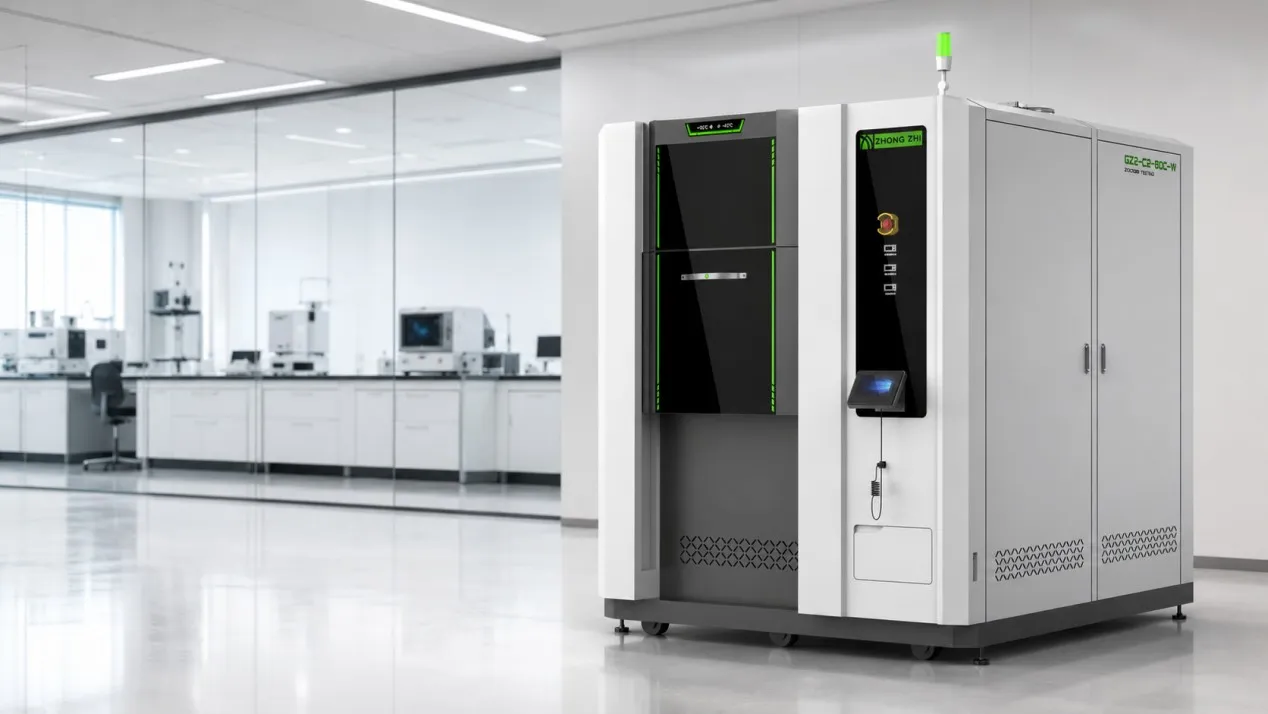
In terms of equipment structure, Thermal Shock Test Chamber (Three Zone) is the preferred choice for automotive-grade chips. The three-zone structure consists of a cold storage chamber, a heat storage chamber, and a test chamber. The sample remains fixed throughout the test and does not move, while the temperature field is switched through air dampers. This structure produces less vibration, making it suitable for precision automotive IC testing. The side of the chamber is also reserved with through-type insulated wiring holes, supporting powered thermal shock testing of chips without opening the door.
Selection points: When selecting equipment for automotive-grade chips, it is necessary to ensure that the equipment fully matches AEC-Q100 and JEDEC JESD22-A104 standards. It is recommended to reserve a temperature margin of 5–10°C during selection to avoid long-term full-load operation and extend the service life of the refrigeration unit. Temperature uniformity should be controlled within ±1.5°C to ensure extremely small temperature differences among multiple chips tested in the same batch.
3. Military-Grade Chips: Extreme Testing Under Extreme Environments
Military-grade chips follow MIL-STD-883 Method 1010.8 (Thermal Shock Test Method for Microelectronic Devices) and GJB 150.5A. The required temperature range is more stringent, generally -65°C to +150°C, while some aerospace-grade applications may even require -70°C to +180°C. Military-grade standards require a temperature change rate of ≥15°C/min and ≥500 cycles.
In terms of equipment structure, military-grade chip testing has extremely high requirements for equipment stability, anti-condensation design, and data traceability. Military-grade testing often involves large-size modules or complete systems, creating clear requirements for walk-in or large customized Thermal Shock Test Chambers.
Selection points: When selecting equipment for military-grade chips, it is necessary to ensure that the equipment meets military standards such as GJB and MIL-STD. Key factors include the equipment's long-term continuous operation capability (supporting more than 1000 uninterrupted thermal shock cycles), anti-condensation purge system (to prevent condensation on the sample surface from causing short circuits), and data management system (supporting program data export and integration with quality systems).
4. Customization Requirements: Differentiated Configurations for Different Grades
The customization requirements of the three types of chips for Thermal Shock Test Chambers differ significantly.
The customization requirements for consumer-grade chips are relatively simple, mainly focusing on the selection of standard volume specifications (such as 50L, 100L, and 200L) and basic program storage functions to adapt to large-batch routine screening on production lines.
The customization requirements for automotive-grade chips are more refined. The temperature range needs to be customized according to different AEC-Q100 temperature grades, dedicated test fixtures need to be customized to accommodate devices with different package specifications, and MES system interfaces need to be customized to achieve automatic data uploading.
Military-grade chip customization is the most complex. It often involves large walk-in chamber customization (with capacities covering 4–100m³ and above), ultra-wide temperature range customization (-80°C to +180°C), high-load-bearing customization (basket load capacity of up to more than 1 ton), as well as special configurations such as explosion-proof and fire protection systems and multiple safety protection measures.
5. How to Choose an Equipment Manufacturer
When choosing a Thermal Shock Test Chamber manufacturer, it is recommended to conduct a comprehensive evaluation from the following four dimensions:
First is technical strength and qualification certifications. Priority should be given to manufacturers with National High-Tech Enterprise qualifications and independent patented technologies. Manufacturers with strong technical expertise have greater advantages in core indicators such as temperature control accuracy, switching speed, and energy-saving design.
Second is product range and customization capabilities. Semiconductor chip categories are highly segmented, and the testing requirements for wafers, consumer ICs, automotive MCUs, power IGBTs, and memory dies are clearly different. Whether the manufacturer provides a full range of products including two-zone, three-zone, and walk-in models, and whether it supports full-dimensional customization from chamber dimensions, temperature and humidity range to load-bearing capacity and air duct design, are important considerations for equipment selection.
Third is industry experience and customer cases. Focus on the manufacturer's actual application cases in semiconductor packaging and testing, automotive electronics, military, and aerospace fields. Rich industry experience means that the manufacturer has a better understanding of the testing pain points of different grades of chips.
Fourth is service system and response capability. Priority should be given to manufacturers with branches, offices, and service outlets in key cities across the country, which can provide localized and vertical services and respond quickly to customer needs.
Comprehensive Advantages of Guangdong Zhongzhi Testing Instruments
Guangdong Zhongzhi Testing Instruments Co., Ltd. was established in 2005 and is a National High-Tech Enterprise integrating the R&D, production, sales, and service of environmental simulation and reliability testing equipment. It is also a Guangdong “Specialized, Specialized and New” Enterprise and a Dongguan listed-company reserve enterprise. The company has more than 300 employees and annual sales exceeding RMB 300 million, with branches and service outlets established in key cities across the country. The company has strong technical capabilities, with more than 100 patents covering three major independent intellectual property systems for refrigeration, temperature control, and structure. Customers are distributed across more than 40 countries and regions worldwide, with support from 30,000+ customer cases.
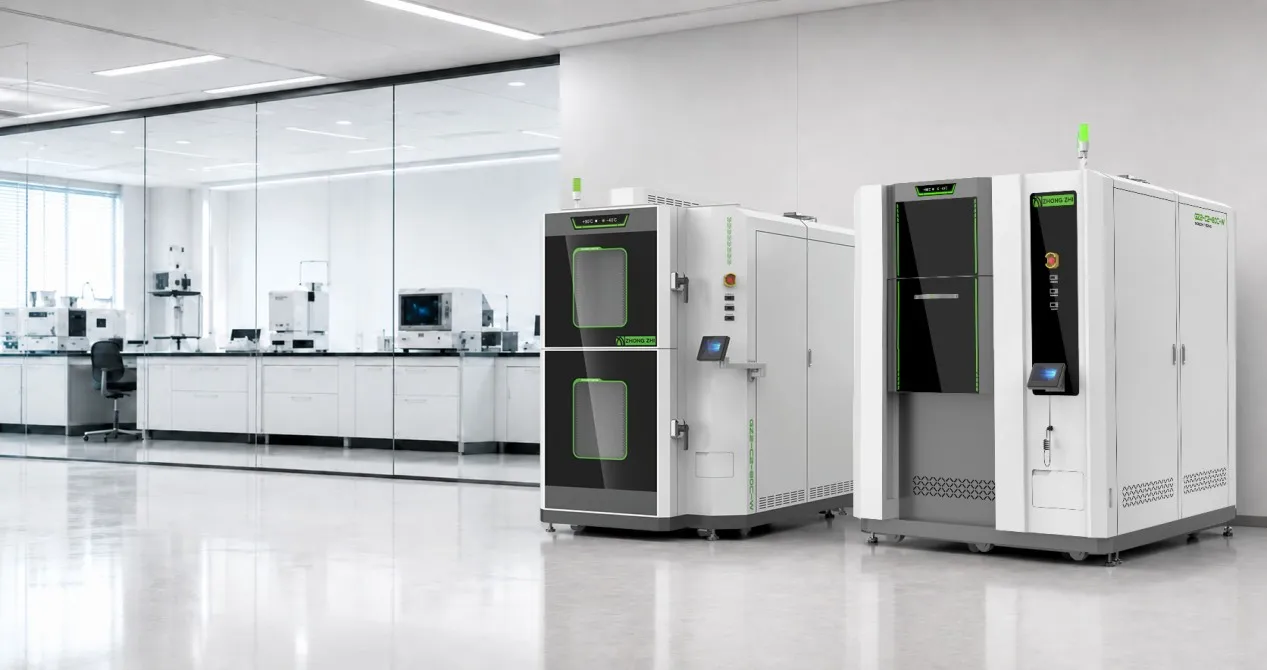
In the field of Thermal Shock Test Chambers, Guangdong Zhongzhi Testing Instruments has significant technical advantages:
Second-level ultra-fast temperature switching. Zhongzhi's independently developed dual-chamber linkage ultra-fast switching structure patent enables a temperature transfer time of ≤8 seconds, far exceeding the industry's conventional 10-second standard. The patented transfer mechanism adopts a customized high-precision pneumatic drive design, with a vibration amplitude of ≤0.1mm, completely avoiding test deviations during sample transfer.
High-precision dual-temperature-zone control system. It adopts a dual-stage cascade high-efficiency refrigeration system and graphene high-efficiency heating technology. The high-temperature zone can reach -20°C to 200°C, while the low-temperature zone can reach as low as -70°C. Temperature fluctuation is ≤±0.3°C, and distribution accuracy is ±2.5°C, effectively solving the problem of test misjudgment caused by insufficient temperature field uniformity in traditional equipment.
Full-scenario product coverage. The product range covers two-zone, three-zone, walk-in, and other full-series Thermal Shock Test Chambers, with capacities covering 4–100m³ and above, supporting full-scenario testing from wafer-level chips to large military components. The products meet domestic and international testing standards such as GB, GJB, IEC, and MIL-STD.
Significant energy-saving advantages. It adopts VRF variable refrigerant flow technology combined with a variable fin spacing high-efficiency evaporator, achieving more than 40% energy savings compared with similar products.
In 2026, as semiconductor processes continue to evolve and reliability requirements continue to increase, the selection of Thermal Shock Test Chambers has evolved from “single equipment procurement” to “scenario-based solution customization.” Whether for mass screening of consumer-grade chips, AEC-Q100 certification of automotive-grade chips, or extreme environmental verification of military-grade chips, choosing an equipment manufacturer with strong technical capabilities, a complete product range, strong customization capabilities, and a comprehensive service system is the key to ensuring valid test data and reliable product delivery. Guangdong Zhongzhi Testing Instruments, relying on more than 20 years of technical expertise, more than 100 patented technologies, full-scenario product coverage, and a global service network, provides systematic solutions for Thermal Shock Testing of different grades of chips.
In 2026, the semiconductor industry continues to evolve toward 3nm and more advanced nodes. The reliability requirements for AI chips, automotive-grade chips, and military-grade chips continue to increase. As a core piece of equipment for verifying potential defects such as chip package delamination, solder joint cracking, and electrical leakage, improper selection of a Thermal Shock Test Chamber will directly lead to distorted test data and missed product defects. Consumer-grade, automotive-grade, and military-grade chips have completely different application scenarios, resulting in fundamental differences in their requirements for Thermal Shock Test Chambers. This article systematically summarizes the key points for selecting equipment for the three types of chips from four dimensions: temperature range, temperature change rate, structural type, and customization requirements.
1. Consumer-Grade Chips: Focus on Cost-Effectiveness and Mass Production Efficiency
Consumer-grade chips (such as Bluetooth, Wi-Fi, memory MCUs, etc.) usually have an operating temperature range of 0°C to 70°C, with relatively less stringent testing standards. The temperature range is generally set at -40°C to +85°C or -55°C to +125°C. A common test condition for consumer-grade memory chips is -40°C ↔ +125°C, 200 cycles.
In terms of equipment structure, Thermal Shock Test Chamber (Two Zone) is the mainstream choice for consumer-grade chips. This type uses a motor to drive the basket to move rapidly between the high-temperature chamber and low-temperature chamber, with a switching time of 10–15 seconds, making it suitable for routine large-batch screening on production lines. The two-zone equipment has a relatively simple structure, moderate investment in procurement and maintenance, and outstanding cost-effectiveness, meeting the mass production testing needs of the consumer electronics industry.
Selection points: When selecting equipment for consumer-grade chips, priority should be given to batch testing efficiency and equipment cost-effectiveness, without the need to pursue ultra-low temperatures and special protection configurations. A standard Thermal Shock Test Chamber (Two Zone) can meet testing requirements such as JEDEC JESD22-A104 Condition A (-55°C/+85°C).
2. Automotive-Grade Chips: High-Reliability Verification Under Stringent Standards
Automotive-grade chips must pass AEC-Q100 certification, which is an authoritative benchmark for screening qualified chip suppliers in the global automotive supply chain. AEC-Q100 divides chips into different temperature grades, among which Grade 0 requires -40°C to +150°C and is the most stringent grade. Automotive-grade chip thermal shock tests generally require a temperature range of -55°C to +150°C, and may even need to cover -65°C to +150°C. The required number of cycles is 500 to 1000, and the temperature change rate is generally required to be 10 to 15°C/min.
In terms of equipment structure, Thermal Shock Test Chamber (Three Zone) is the preferred choice for automotive-grade chips. The three-zone structure consists of a cold storage chamber, a heat storage chamber, and a test chamber. The sample remains fixed throughout the test and does not move, while the temperature field is switched through air dampers. This structure produces less vibration, making it suitable for precision automotive IC testing. The side of the chamber is also reserved with through-type insulated wiring holes, supporting powered thermal shock testing of chips without opening the door.
Selection points: When selecting equipment for automotive-grade chips, it is necessary to ensure that the equipment fully matches AEC-Q100 and JEDEC JESD22-A104 standards. It is recommended to reserve a temperature margin of 5–10°C during selection to avoid long-term full-load operation and extend the service life of the refrigeration unit. Temperature uniformity should be controlled within ±1.5°C to ensure extremely small temperature differences among multiple chips tested in the same batch.
3. Military-Grade Chips: Extreme Testing Under Extreme Environments
Military-grade chips follow MIL-STD-883 Method 1010.8 (Thermal Shock Test Method for Microelectronic Devices) and GJB 150.5A. The required temperature range is more stringent, generally -65°C to +150°C, while some aerospace-grade applications may even require -70°C to +180°C. Military-grade standards require a temperature change rate of ≥15°C/min and ≥500 cycles.
In terms of equipment structure, military-grade chip testing has extremely high requirements for equipment stability, anti-condensation design, and data traceability. Military-grade testing often involves large-size modules or complete systems, creating clear requirements for walk-in or large customized Thermal Shock Test Chambers.
Selection points: When selecting equipment for military-grade chips, it is necessary to ensure that the equipment meets military standards such as GJB and MIL-STD. Key factors include the equipment's long-term continuous operation capability (supporting more than 1000 uninterrupted thermal shock cycles), anti-condensation purge system (to prevent condensation on the sample surface from causing short circuits), and data management system (supporting program data export and integration with quality systems).
4. Customization Requirements: Differentiated Configurations for Different Grades
The customization requirements of the three types of chips for Thermal Shock Test Chambers differ significantly.
The customization requirements for consumer-grade chips are relatively simple, mainly focusing on the selection of standard volume specifications (such as 50L, 100L, and 200L) and basic program storage functions to adapt to large-batch routine screening on production lines.
The customization requirements for automotive-grade chips are more refined. The temperature range needs to be customized according to different AEC-Q100 temperature grades, dedicated test fixtures need to be customized to accommodate devices with different package specifications, and MES system interfaces need to be customized to achieve automatic data uploading.
Military-grade chip customization is the most complex. It often involves large walk-in chamber customization (with capacities covering 4–100m³ and above), ultra-wide temperature range customization (-80°C to +180°C), high-load-bearing customization (basket load capacity of up to more than 1 ton), as well as special configurations such as explosion-proof and fire protection systems and multiple safety protection measures.
5. How to Choose an Equipment Manufacturer
When choosing a Thermal Shock Test Chamber manufacturer, it is recommended to conduct a comprehensive evaluation from the following four dimensions:
First is technical strength and qualification certifications. Priority should be given to manufacturers with National High-Tech Enterprise qualifications and independent patented technologies. Manufacturers with strong technical expertise have greater advantages in core indicators such as temperature control accuracy, switching speed, and energy-saving design.
Second is product range and customization capabilities. Semiconductor chip categories are highly segmented, and the testing requirements for wafers, consumer ICs, automotive MCUs, power IGBTs, and memory dies are clearly different. Whether the manufacturer provides a full range of products including two-zone, three-zone, and walk-in models, and whether it supports full-dimensional customization from chamber dimensions, temperature and humidity range to load-bearing capacity and air duct design, are important considerations for equipment selection.
Third is industry experience and customer cases. Focus on the manufacturer's actual application cases in semiconductor packaging and testing, automotive electronics, military, and aerospace fields. Rich industry experience means that the manufacturer has a better understanding of the testing pain points of different grades of chips.
Fourth is service system and response capability. Priority should be given to manufacturers with branches, offices, and service outlets in key cities across the country, which can provide localized and vertical services and respond quickly to customer needs.
Comprehensive Advantages of Guangdong Zhongzhi Testing Instruments
Guangdong Zhongzhi Testing Instruments Co., Ltd. was established in 2005 and is a National High-Tech Enterprise integrating the R&D, production, sales, and service of environmental simulation and reliability testing equipment. It is also a Guangdong “Specialized, Specialized and New” Enterprise and a Dongguan listed-company reserve enterprise. The company has more than 300 employees and annual sales exceeding RMB 300 million, with branches and service outlets established in key cities across the country. The company has strong technical capabilities, with more than 100 patents covering three major independent intellectual property systems for refrigeration, temperature control, and structure. Customers are distributed across more than 40 countries and regions worldwide, with support from 30,000+ customer cases.
In the field of Thermal Shock Test Chambers, Guangdong Zhongzhi Testing Instruments has significant technical advantages:
Second-level ultra-fast temperature switching. Zhongzhi's independently developed dual-chamber linkage ultra-fast switching structure patent enables a temperature transfer time of ≤8 seconds, far exceeding the industry's conventional 10-second standard. The patented transfer mechanism adopts a customized high-precision pneumatic drive design, with a vibration amplitude of ≤0.1mm, completely avoiding test deviations during sample transfer.
High-precision dual-temperature-zone control system. It adopts a dual-stage cascade high-efficiency refrigeration system and graphene high-efficiency heating technology. The high-temperature zone can reach -20°C to 200°C, while the low-temperature zone can reach as low as -70°C. Temperature fluctuation is ≤±0.3°C, and distribution accuracy is ±2.5°C, effectively solving the problem of test misjudgment caused by insufficient temperature field uniformity in traditional equipment.
Full-scenario product coverage. The product range covers two-zone, three-zone, walk-in, and other full-series Thermal Shock Test Chambers, with capacities covering 4–100m³ and above, supporting full-scenario testing from wafer-level chips to large military components. The products meet domestic and international testing standards such as GB, GJB, IEC, and MIL-STD.
Significant energy-saving advantages. It adopts VRF variable refrigerant flow technology combined with a variable fin spacing high-efficiency evaporator, achieving more than 40% energy savings compared with similar products.
In 2026, as semiconductor processes continue to evolve and reliability requirements continue to increase, the selection of Thermal Shock Test Chambers has evolved from “single equipment procurement” to “scenario-based solution customization.” Whether for mass screening of consumer-grade chips, AEC-Q100 certification of automotive-grade chips, or extreme environmental verification of military-grade chips, choosing an equipment manufacturer with strong technical capabilities, a complete product range, strong customization capabilities, and a comprehensive service system is the key to ensuring valid test data and reliable product delivery. Guangdong Zhongzhi Testing Instruments, relying on more than 20 years of technical expertise, more than 100 patented technologies, full-scenario product coverage, and a global service network, provides systematic solutions for Thermal Shock Testing of different grades of chips.

Contact Us
Tel: +86 136 1604 6535
Address: No. 417, Shatian Section, Gangkou Road, Shatian Town, Dongguan City, Guangdong Province, China
Copyright © 2026 Guangdong Zhongzhi Testing Instruments Co., Ltd.