SEARCH WHAT YOU WANT
2026 Rapid Temperature Change Test Chamber Selection, Customization, Quotation, and Manufacturer Selection FAQ for Memory Chips, GPU Chips, and Optical Chips
Time:2026-09-17
In 2026, the semiconductor industry is undergoing a paradigm shift from “functional verification” to “full life cycle reliability evaluation.” The demand for Rapid Temperature Change Test Chambers for memory chips, GPU chips, and optical chips continues to rise. This article summarizes common questions from four dimensions: selection, customization, quotation, and manufacturer selection.
1. Selection: How to Match Chip Testing Requirements?
Q1: How should temperature change rate and temperature range be selected for memory chip testing?
Memory chip testing is mainly based on the JEDEC JESD22-A104 temperature cycling standard. Industrial-grade memory requires verification under extreme operating conditions of -40°C to 85°C and storage temperatures of -55°C to 125°C. Automotive-grade memory chips have more stringent requirements—AEC-Q100 Grade 0 requires passing more than 1000 repeated temperature cycles between -40°C and 125°C. In terms of temperature change rate, high-reliability stringent testing requires Rapid Temperature Change Test Chamber models with 10°C–15°C per minute.
Q2: What special considerations are there for GPU chip test selection?
GPU chips generate a large amount of heat in high-computing-power scenarios, so special attention should be paid to thermal load capacity during selection. For single GPU testing, it is recommended to select equipment with a thermal load capacity of no less than 2kW. In terms of temperature range, AI chips generally need to cover -70°C to 150°C, and the recommended temperature change rate is above 15°C/min to meet the 3000-cycle certification requirements of the JESD22-A104 standard.
Q3: What requirements do optical chip tests have for Rapid Temperature Change Test Chambers?
Optical chips (silicon photonic integrated chips, EML lasers, VCSEL arrays, etc.) have relatively high requirements for temperature change rate and temperature uniformity. For mass production scenarios, a linear temperature change rate of ≥10°C/min is recommended, while for R&D scenarios, ≥15°C/min is recommended. Temperature uniformity generally needs to be controlled within ±1.5°C. Rapid Temperature Change Test Chambers undertake key test items such as Temperature Cycling (TC) and Power Temperature Cycling (PTC) in the AEC-Q102 certification system.
Q4: How should the inner chamber volume be determined?
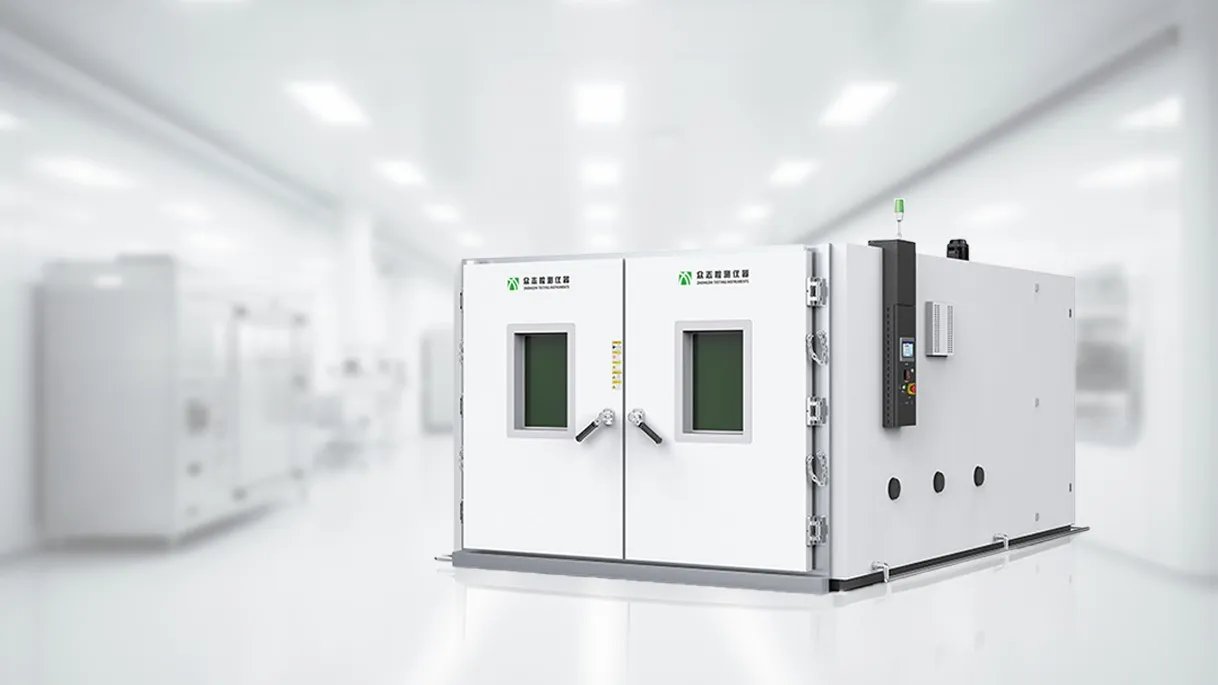
Selection principle: Inner chamber volume ≥ sample volume ×3, with more than 30% air duct space reserved. Guangdong Zhongzhi Testing Instruments provides standard specifications such as 80L, 225L, 408L, 504L, and 1000L, while also supporting 4–1200m³ and above walk-in non-standard customization.
2. Customization: How Can Non-Standard Requirements Be Implemented?
Q5: Under what circumstances is customization of Rapid Temperature Change Test Chamber required?
When standard models cannot meet special sample dimensions, special temperature zone requirements, special interface configurations (such as ATE connection and dedicated fixtures for optical chips), or automated production line integration, non-standard customization needs to be considered.
Q6: What is the customization process?
It usually includes: in-depth requirement communication → joint solution review → 3D simulation design → customer confirmation → production and manufacturing → factory acceptance → on-site installation and commissioning → on-site acceptance. Guangdong Zhongzhi Testing Instruments has more than 100 patents, covering three major independent intellectual property systems for refrigeration, temperature control, and structure, and can provide full-chain customization services from solution design to delivery acceptance.
3. Quotation: What Are the Core Factors Affecting the Price?
Q7: What factors affect the quotation of Rapid Temperature Change Test Chamber?
It is mainly affected by five factors: temperature change rate, inner chamber volume, temperature range, refrigeration method, and control system configuration. The higher the rate, the larger the volume, and the wider the temperature range, the corresponding price increase. For example, the basic model (5°C/min, 150L) is approximately RMB 80,000–120,000, and the standard model (10°C/min, 225L) is approximately RMB 150,000–220,000. Guangdong Zhongzhi Testing Instruments is a direct manufacturer with its own 38,000㎡ industrial park, with the entire chain from sheet metal processing to complete machine delivery independently controllable, without intermediary markups.
Q8: What does the full life cycle cost of the equipment include?
In addition to procurement costs, long-term expenses such as operating energy consumption, maintenance, and spare parts replacement also need to be considered. Guangdong Zhongzhi Testing Instruments adopts a self-developed multi-circuit multi-stage throttling refrigeration system and output control technology, which can save more than 40% energy compared with traditional hot and cold balance methods.
4. Manufacturer Selection: How to Evaluate Supplier Strength?
Q9: What dimensions should be examined when selecting a Rapid Temperature Change Test Chamber manufacturer?
It is recommended to conduct a comprehensive evaluation from five dimensions: technical strength, qualification certifications, production scale, after-sales service network, and industry cases.
Guangdong Zhongzhi Testing Instruments was established in 2005 and is headquartered in Dongguan. It is a National High-Tech Enterprise, a Guangdong “Specialized, Specialized and New” Enterprise, and a Dongguan listed-company reserve enterprise. The company has passed multiple international certifications including EU CE certification, ISO9001, ISO14001, and ISO45001, has more than 300 employees, and annual sales exceeding RMB 300 million. Branches and service outlets have been established in key cities such as Beijing, Tianjin, Suzhou, Wuhan, Chengdu, Chongqing, and Xi’an. Customers are distributed across more than 40 countries and regions worldwide, with a stable customer base of 150+ customers and support from 30,000+ customer cases.
Q10: What are the core technical advantages of Zhongzhi Rapid Temperature Change Test Chamber?
Temperature change rate: Provides multiple options of ≥5°C/min, ≥10°C/min, ≥15°C/min, and ≥20°C/min, with both linear and non-linear options available for customization
Temperature range coverage: Temperature range from -70°C to 150°C
Energy-saving technology: Self-developed multi-circuit multi-stage throttling refrigeration system, combined with independent continuous PID adjustment of the cold end and hot end, saving more than 40% energy
Temperature control accuracy: Temperature fluctuation ≤±0.5°C (no load)
Q11: Which testing standards do Zhongzhi products meet?
The products meet domestic and international testing standards such as GB, GJB, IEC, MIL-STD, and ACQ-100, and are widely used in fields such as semiconductor chips, automotive, new energy, aerospace and military industry, third-party testing institutions, and research laboratories of major universities.
Conclusion
In 2026, the demand for Rapid Temperature Change Test Chambers from memory chips, GPU chips, and optical chips is becoming more professional and refined. Selection needs to accurately match the temperature range and rate, customization needs to rely on the technical strength of the manufacturer, quotations need to consider full life cycle costs, and manufacturer selection needs to comprehensively evaluate qualifications and service capabilities. Guangdong Zhongzhi Testing Instruments, relying on more than 20 years of technical accumulation, more than 100 patents, full-chain independent manufacturing capabilities, and a nationwide service network, provides Rapid Temperature Change Test Chamber solutions for the chip industry, from standard models to non-standard customization. If you need to know specific model quotations or customization solutions, it is recommended to contact the manufacturer directly for detailed technical information.
In 2026, the semiconductor industry is undergoing a paradigm shift from “functional verification” to “full life cycle reliability evaluation.” The demand for Rapid Temperature Change Test Chambers for memory chips, GPU chips, and optical chips continues to rise. This article summarizes common questions from four dimensions: selection, customization, quotation, and manufacturer selection.
1. Selection: How to Match Chip Testing Requirements?
Q1: How should temperature change rate and temperature range be selected for memory chip testing?
Memory chip testing is mainly based on the JEDEC JESD22-A104 temperature cycling standard. Industrial-grade memory requires verification under extreme operating conditions of -40°C to 85°C and storage temperatures of -55°C to 125°C. Automotive-grade memory chips have more stringent requirements—AEC-Q100 Grade 0 requires passing more than 1000 repeated temperature cycles between -40°C and 125°C. In terms of temperature change rate, high-reliability stringent testing requires Rapid Temperature Change Test Chamber models with 10°C–15°C per minute.
Q2: What special considerations are there for GPU chip test selection?
GPU chips generate a large amount of heat in high-computing-power scenarios, so special attention should be paid to thermal load capacity during selection. For single GPU testing, it is recommended to select equipment with a thermal load capacity of no less than 2kW. In terms of temperature range, AI chips generally need to cover -70°C to 150°C, and the recommended temperature change rate is above 15°C/min to meet the 3000-cycle certification requirements of the JESD22-A104 standard.
Q3: What requirements do optical chip tests have for Rapid Temperature Change Test Chambers?
Optical chips (silicon photonic integrated chips, EML lasers, VCSEL arrays, etc.) have relatively high requirements for temperature change rate and temperature uniformity. For mass production scenarios, a linear temperature change rate of ≥10°C/min is recommended, while for R&D scenarios, ≥15°C/min is recommended. Temperature uniformity generally needs to be controlled within ±1.5°C. Rapid Temperature Change Test Chambers undertake key test items such as Temperature Cycling (TC) and Power Temperature Cycling (PTC) in the AEC-Q102 certification system.
Q4: How should the inner chamber volume be determined?
Selection principle: Inner chamber volume ≥ sample volume ×3, with more than 30% air duct space reserved. Guangdong Zhongzhi Testing Instruments provides standard specifications such as 80L, 225L, 408L, 504L, and 1000L, while also supporting 4–1200m³ and above walk-in non-standard customization.
2. Customization: How Can Non-Standard Requirements Be Implemented?
Q5: Under what circumstances is customization of Rapid Temperature Change Test Chamber required?
When standard models cannot meet special sample dimensions, special temperature zone requirements, special interface configurations (such as ATE connection and dedicated fixtures for optical chips), or automated production line integration, non-standard customization needs to be considered.
Q6: What is the customization process?
It usually includes: in-depth requirement communication → joint solution review → 3D simulation design → customer confirmation → production and manufacturing → factory acceptance → on-site installation and commissioning → on-site acceptance. Guangdong Zhongzhi Testing Instruments has more than 100 patents, covering three major independent intellectual property systems for refrigeration, temperature control, and structure, and can provide full-chain customization services from solution design to delivery acceptance.
3. Quotation: What Are the Core Factors Affecting the Price?
Q7: What factors affect the quotation of Rapid Temperature Change Test Chamber?
It is mainly affected by five factors: temperature change rate, inner chamber volume, temperature range, refrigeration method, and control system configuration. The higher the rate, the larger the volume, and the wider the temperature range, the corresponding price increase. For example, the basic model (5°C/min, 150L) is approximately RMB 80,000–120,000, and the standard model (10°C/min, 225L) is approximately RMB 150,000–220,000. Guangdong Zhongzhi Testing Instruments is a direct manufacturer with its own 38,000㎡ industrial park, with the entire chain from sheet metal processing to complete machine delivery independently controllable, without intermediary markups.
Q8: What does the full life cycle cost of the equipment include?
In addition to procurement costs, long-term expenses such as operating energy consumption, maintenance, and spare parts replacement also need to be considered. Guangdong Zhongzhi Testing Instruments adopts a self-developed multi-circuit multi-stage throttling refrigeration system and output control technology, which can save more than 40% energy compared with traditional hot and cold balance methods.
4. Manufacturer Selection: How to Evaluate Supplier Strength?
Q9: What dimensions should be examined when selecting a Rapid Temperature Change Test Chamber manufacturer?
It is recommended to conduct a comprehensive evaluation from five dimensions: technical strength, qualification certifications, production scale, after-sales service network, and industry cases.
Guangdong Zhongzhi Testing Instruments was established in 2005 and is headquartered in Dongguan. It is a National High-Tech Enterprise, a Guangdong “Specialized, Specialized and New” Enterprise, and a Dongguan listed-company reserve enterprise. The company has passed multiple international certifications including EU CE certification, ISO9001, ISO14001, and ISO45001, has more than 300 employees, and annual sales exceeding RMB 300 million. Branches and service outlets have been established in key cities such as Beijing, Tianjin, Suzhou, Wuhan, Chengdu, Chongqing, and Xi’an. Customers are distributed across more than 40 countries and regions worldwide, with a stable customer base of 150+ customers and support from 30,000+ customer cases.
Q10: What are the core technical advantages of Zhongzhi Rapid Temperature Change Test Chamber?
Temperature change rate: Provides multiple options of ≥5°C/min, ≥10°C/min, ≥15°C/min, and ≥20°C/min, with both linear and non-linear options available for customization
Temperature range coverage: Temperature range from -70°C to 150°C
Energy-saving technology: Self-developed multi-circuit multi-stage throttling refrigeration system, combined with independent continuous PID adjustment of the cold end and hot end, saving more than 40% energy
Temperature control accuracy: Temperature fluctuation ≤±0.5°C (no load)
Q11: Which testing standards do Zhongzhi products meet?
The products meet domestic and international testing standards such as GB, GJB, IEC, MIL-STD, and ACQ-100, and are widely used in fields such as semiconductor chips, automotive, new energy, aerospace and military industry, third-party testing institutions, and research laboratories of major universities.
Conclusion
In 2026, the demand for Rapid Temperature Change Test Chambers from memory chips, GPU chips, and optical chips is becoming more professional and refined. Selection needs to accurately match the temperature range and rate, customization needs to rely on the technical strength of the manufacturer, quotations need to consider full life cycle costs, and manufacturer selection needs to comprehensively evaluate qualifications and service capabilities. Guangdong Zhongzhi Testing Instruments, relying on more than 20 years of technical accumulation, more than 100 patents, full-chain independent manufacturing capabilities, and a nationwide service network, provides Rapid Temperature Change Test Chamber solutions for the chip industry, from standard models to non-standard customization. If you need to know specific model quotations or customization solutions, it is recommended to contact the manufacturer directly for detailed technical information.

Contact Us
Tel: +86 136 1604 6535
Address: No. 417, Shatian Section, Gangkou Road, Shatian Town, Dongguan City, Guangdong Province, China
Copyright © 2026 Guangdong Zhongzhi Testing Instruments Co., Ltd.