SEARCH WHAT YOU WANT
2026 Optical Module Environmental Test Standards Intensively Updated, Bringing a “Hard-Core” New Test for Reliability Verification
Time:2026-09-17
Just halfway through 2026, the optical module industry has already ushered in a wave of standards updates. YD/T 2005-2026 Optical Transceiver Modules for Fibre Channel was released in March and officially implemented in June; YD/T 2798.3-2026 and several other test method standards have also been successively implemented. At the same time, the combined edition of IEC 62343 Dynamic Modules, 2023 Edition + AMD1:2026, was released at the beginning of the year. Behind the accelerated iteration of the standards system is the evolution of 400G/800G optical modules toward miniaturization and high density, which has put forward higher requirements for reliability verification.
1. The “Puzzle” of Standards Is Becoming More Complete, and Environmental Testing Has Become a Hard Requirement
The core standard for optical module environmental reliability testing remains Telcordia GR-468-CORE (Issue 2, 2004), which requires devices to have an expected service life of more than 20 years. At the same time, MIL-STD-883G/K, GB/T 21194-2007, the IEC 60068 series, and the domestically issued YD/T series standards together form a complete testing standards system.
According to GR-468-CORE, optical module environmental reliability tests are divided into two major categories: non-operating environmental tests and operating environmental tests:
High-temperature storage: 85°C, for 2000 hours;
Low-temperature storage: -40°C, for 72 hours;
Temperature cycling: -40°C to 85°C, 500 cycles, requiring a temperature change rate ≥10°C/min;
Damp heat, steady state: 85°C/85%RH “85/85”, for 500 hours;
High-temperature life test: 70°C or 85°C, for 2000 hours.
After completion of each test, the change in key performance indicators of the optical module must be ≤1.0dB (1.5dB for the life test). For every 1°C deviation in temperature, the accelerated aging factor may shift by 15%–20%, while excessive humidity may cause optical fiber microbending loss or even irreversible failure.
2. Testing Challenges Are Upgrading, and Equipment Capabilities Face a “Major Test”
As standards become increasingly stringent, testing pain points have also emerged:
Pain Point One: The temperature change rate cannot keep up. The requirement of 500 temperature cycles and a rate ≥10°C/min means that traditional equipment can often take several months, seriously affecting the product launch schedule.
Pain Point Two: Insufficient temperature field uniformity. Excessive temperature differences at different positions inside the chamber result in inconsistent test results for samples from the same batch, with a high misjudgment rate.
Pain Point Three: High risk of condensation corrosion. Optical modules contain precision optical lenses and laser chips. Condensed water during temperature and humidity cycling may cause pin oxidation, contamination of optical interfaces, and even moisture-induced failure of laser chips.
Pain Point Four: Uncertain stability under extreme operating conditions. At extreme coupled points such as “85/85”, deviations in equipment temperature and humidity control increase, making it difficult to ensure the repeatability of test data.

3. Zhongzhi Testing Instruments: Responding to Standards Upgrades with Technical Strength
In response to the testing challenges brought by standards upgrades, Guangdong Zhongzhi Testing Instruments Co., Ltd., established in 2005, has been deeply engaged in environmental test equipment for more than 20 years. It is a National High-Tech Enterprise and a Guangdong Specialized, Specialized and New Enterprise, with more than 100 technical patents. For the optical module industry, Zhongzhi has launched an overall environmental reliability testing solution for optical modules, covering the entire testing process from R&D samples to mass production and from chip-level to module-level testing scenarios.
● Rapid Temperature Change Test Chamber: Bringing 500 Cycles into Several Weeks
Zhongzhi CZ-USA Series Rapid Temperature Change Test Chamber supports multiple linear temperature rise and fall rates, including 5°C/min, 10°C/min, 15°C/min, and 20°C/min, which fully covers and exceeds the 10°C/min rate requirement of GR-468-CORE. The independently developed patented technology for full-range balanced rapid temperature control enables free adjustment of linear constant-speed temperature rise and fall rates from 0.1°C/min to 25°C/min, with no temperature difference discontinuity or rate stagnation throughout the process. Taking the 500-cycle temperature cycling verification of optical modules as an example, the test cycle can be shortened from several months with traditional equipment to several weeks, greatly accelerating the product launch schedule.
● High-Precision Temperature Control: Eliminating “Position Differences” at the Source
The equipment achieves temperature fluctuation of <±0.25°C and uniformity of ≤±1.5°C, far exceeding the general requirements of GR-468. Through multi-channel sensor zone sampling and dynamic PID adaptive adjustment algorithms, it ensures a highly consistent temperature field in any space and at any time inside the chamber. The patented technology for segmented adjustment of cooling and heating capacity in the air duct (ZL 2025 20233946.6), through the installation of a volute, auxiliary heater, and air-adjusting louvers inside the air duct, enables manual or automatic segmented adjustment of the distribution of cooling and heating capacity in the upper and lower areas, eliminating vertical temperature differences in the test area. Regardless of whether the optical module is placed on the upper, middle, or lower layer, test consistency is ≥99%, and the misjudgment rate is reduced from 15% to 2%.
● Patented Anti-Condensation: Putting a “Protective Suit” on Precision Optical Devices
The independently developed patented anti-condensation structure and test chamber (ZL 2025 20312670.0) uses closed-loop control of the temperature at the outer end of the terminal through a temperature adjustment component + dual temperature sensors + controller, effectively eliminating condensation at the terminal during low-temperature high-humidity or temperature and humidity cycling. Combined with the patented anti-condensation air duct and heated observation window design, it enables frost-free and fog-free operation at low temperatures while allowing real-time observation of module status.
● Wide Temperature Range Coverage + Energy-Saving Operation: Balancing Performance and Cost
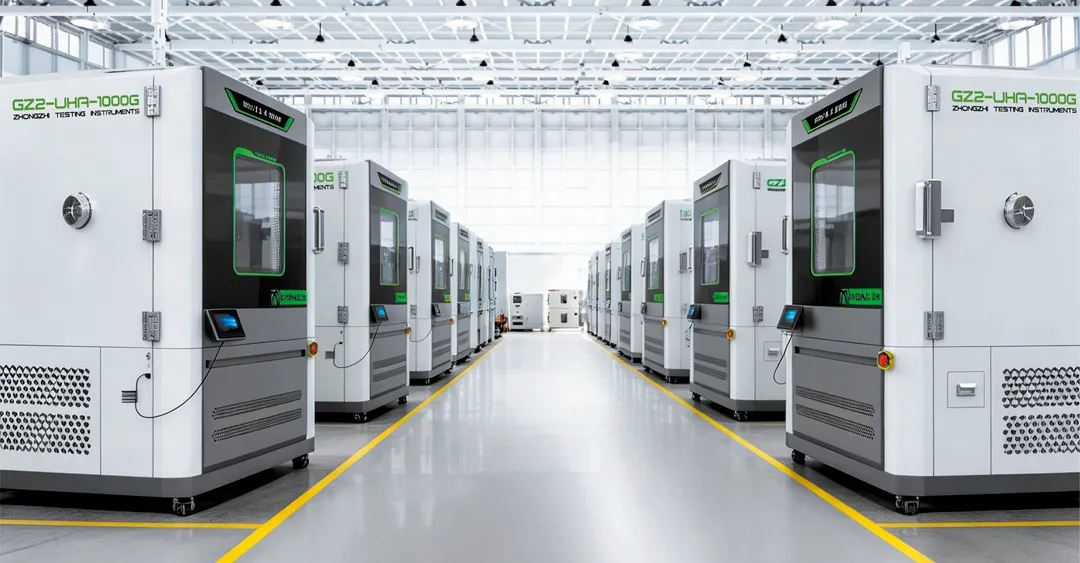
Zhongzhi Temperature Test Chamber adopts a balanced temperature and humidity control system (BTHC), achieving wide temperature range coverage of -70°C to +150°C, with a humidity range of 5%–98%RH. At the extreme coupled point of 85°C/85%RH “85/85”, it can still maintain the deviation band without expansion. Product specifications include 20L benchtop models, 80L to 1000L standard models, and large walk-in test chambers, meeting the different application needs of R&D testing and mass production batch testing. The second-generation advanced linear refrigerant control technology saves 40% energy compared with traditional control technology.
Conclusion
From GR-468 to the YD/T series, and from IEC 62343 to MIL-STD, the optical module environmental testing standards system is being improved at an unprecedented speed. Standards are changing, but the pursuit of reliability remains unchanged. Guangdong Zhongzhi Testing Instruments, with its independently developed patented technology system, provides optical module companies with full-process testing assurance from R&D to mass production, helping the Chinese optical communications industry develop reliably amid the wave of standards upgrades.
Just halfway through 2026, the optical module industry has already ushered in a wave of standards updates. YD/T 2005-2026 Optical Transceiver Modules for Fibre Channel was released in March and officially implemented in June; YD/T 2798.3-2026 and several other test method standards have also been successively implemented. At the same time, the combined edition of IEC 62343 Dynamic Modules, 2023 Edition + AMD1:2026, was released at the beginning of the year. Behind the accelerated iteration of the standards system is the evolution of 400G/800G optical modules toward miniaturization and high density, which has put forward higher requirements for reliability verification.
1. The “Puzzle” of Standards Is Becoming More Complete, and Environmental Testing Has Become a Hard Requirement
The core standard for optical module environmental reliability testing remains Telcordia GR-468-CORE (Issue 2, 2004), which requires devices to have an expected service life of more than 20 years. At the same time, MIL-STD-883G/K, GB/T 21194-2007, the IEC 60068 series, and the domestically issued YD/T series standards together form a complete testing standards system.
According to GR-468-CORE, optical module environmental reliability tests are divided into two major categories: non-operating environmental tests and operating environmental tests:
High-temperature storage: 85°C, for 2000 hours;
Low-temperature storage: -40°C, for 72 hours;
Temperature cycling: -40°C to 85°C, 500 cycles, requiring a temperature change rate ≥10°C/min;
Damp heat, steady state: 85°C/85%RH “85/85”, for 500 hours;
High-temperature life test: 70°C or 85°C, for 2000 hours.
After completion of each test, the change in key performance indicators of the optical module must be ≤1.0dB (1.5dB for the life test). For every 1°C deviation in temperature, the accelerated aging factor may shift by 15%–20%, while excessive humidity may cause optical fiber microbending loss or even irreversible failure.
2. Testing Challenges Are Upgrading, and Equipment Capabilities Face a “Major Test”
As standards become increasingly stringent, testing pain points have also emerged:
Pain Point One: The temperature change rate cannot keep up. The requirement of 500 temperature cycles and a rate ≥10°C/min means that traditional equipment can often take several months, seriously affecting the product launch schedule.
Pain Point Two: Insufficient temperature field uniformity. Excessive temperature differences at different positions inside the chamber result in inconsistent test results for samples from the same batch, with a high misjudgment rate.
Pain Point Three: High risk of condensation corrosion. Optical modules contain precision optical lenses and laser chips. Condensed water during temperature and humidity cycling may cause pin oxidation, contamination of optical interfaces, and even moisture-induced failure of laser chips.
Pain Point Four: Uncertain stability under extreme operating conditions. At extreme coupled points such as “85/85”, deviations in equipment temperature and humidity control increase, making it difficult to ensure the repeatability of test data.
3. Zhongzhi Testing Instruments: Responding to Standards Upgrades with Technical Strength
In response to the testing challenges brought by standards upgrades, Guangdong Zhongzhi Testing Instruments Co., Ltd., established in 2005, has been deeply engaged in environmental test equipment for more than 20 years. It is a National High-Tech Enterprise and a Guangdong Specialized, Specialized and New Enterprise, with more than 100 technical patents. For the optical module industry, Zhongzhi has launched an overall environmental reliability testing solution for optical modules, covering the entire testing process from R&D samples to mass production and from chip-level to module-level testing scenarios.
● Rapid Temperature Change Test Chamber: Bringing 500 Cycles into Several Weeks
Zhongzhi CZ-USA Series Rapid Temperature Change Test Chamber supports multiple linear temperature rise and fall rates, including 5°C/min, 10°C/min, 15°C/min, and 20°C/min, which fully covers and exceeds the 10°C/min rate requirement of GR-468-CORE. The independently developed patented technology for full-range balanced rapid temperature control enables free adjustment of linear constant-speed temperature rise and fall rates from 0.1°C/min to 25°C/min, with no temperature difference discontinuity or rate stagnation throughout the process. Taking the 500-cycle temperature cycling verification of optical modules as an example, the test cycle can be shortened from several months with traditional equipment to several weeks, greatly accelerating the product launch schedule.
● High-Precision Temperature Control: Eliminating “Position Differences” at the Source
The equipment achieves temperature fluctuation of <±0.25°C and uniformity of ≤±1.5°C, far exceeding the general requirements of GR-468. Through multi-channel sensor zone sampling and dynamic PID adaptive adjustment algorithms, it ensures a highly consistent temperature field in any space and at any time inside the chamber. The patented technology for segmented adjustment of cooling and heating capacity in the air duct (ZL 2025 20233946.6), through the installation of a volute, auxiliary heater, and air-adjusting louvers inside the air duct, enables manual or automatic segmented adjustment of the distribution of cooling and heating capacity in the upper and lower areas, eliminating vertical temperature differences in the test area. Regardless of whether the optical module is placed on the upper, middle, or lower layer, test consistency is ≥99%, and the misjudgment rate is reduced from 15% to 2%.
● Patented Anti-Condensation: Putting a “Protective Suit” on Precision Optical Devices
The independently developed patented anti-condensation structure and test chamber (ZL 2025 20312670.0) uses closed-loop control of the temperature at the outer end of the terminal through a temperature adjustment component + dual temperature sensors + controller, effectively eliminating condensation at the terminal during low-temperature high-humidity or temperature and humidity cycling. Combined with the patented anti-condensation air duct and heated observation window design, it enables frost-free and fog-free operation at low temperatures while allowing real-time observation of module status.
● Wide Temperature Range Coverage + Energy-Saving Operation: Balancing Performance and Cost
Zhongzhi Temperature Test Chamber adopts a balanced temperature and humidity control system (BTHC), achieving wide temperature range coverage of -70°C to +150°C, with a humidity range of 5%–98%RH. At the extreme coupled point of 85°C/85%RH “85/85”, it can still maintain the deviation band without expansion. Product specifications include 20L benchtop models, 80L to 1000L standard models, and large walk-in test chambers, meeting the different application needs of R&D testing and mass production batch testing. The second-generation advanced linear refrigerant control technology saves 40% energy compared with traditional control technology.
Conclusion
From GR-468 to the YD/T series, and from IEC 62343 to MIL-STD, the optical module environmental testing standards system is being improved at an unprecedented speed. Standards are changing, but the pursuit of reliability remains unchanged. Guangdong Zhongzhi Testing Instruments, with its independently developed patented technology system, provides optical module companies with full-process testing assurance from R&D to mass production, helping the Chinese optical communications industry develop reliably amid the wave of standards upgrades.

Contact Us
Tel: +86 136 1604 6535
Address: No. 417, Shatian Section, Gangkou Road, Shatian Town, Dongguan City, Guangdong Province, China
Copyright © 2026 Guangdong Zhongzhi Testing Instruments Co., Ltd.